CLINIC PROFILE
IN CLINIC WITH DR LISA DINLEY
With a career spanning dentistry, aesthetics and advanced clinical education, Dr Lisa Dinley speaks to editor Kezia Parkins about why evidence, safety and integrity must outweigh trends, hype and follower counts
If you don’t know Dr Lisa Dinley, chances are you’ve seen her. Whether speaking on conference stages or leading advanced educational events, she is instantly recognisable – not only for her iconic flame-red hair, but for her uncompromising intelligence and depth of knowledge in aesthetic medicine.
Every time I have seen Dr Dinley speak, I have found myself captivated by her ability to distil complex medical aesthetic research into meaningful, practical insights. She describes herself as “a bit of a geek”, reading an average of five medical papers a day, often simply for the joy of learning, and frequently while out walking her dog.
Renowned for developing treatment protocols and education for global brands such as Fillmed, Dr Dinley is deeply committed to strengthening the evidence base within aesthetic medicine. She conducts her own clinical research, is regularly published in peerreviewed journals, and sits on the Elsevier advisory board, acting as a reviewer for multiple aesthetic and cosmetic surgery publications.
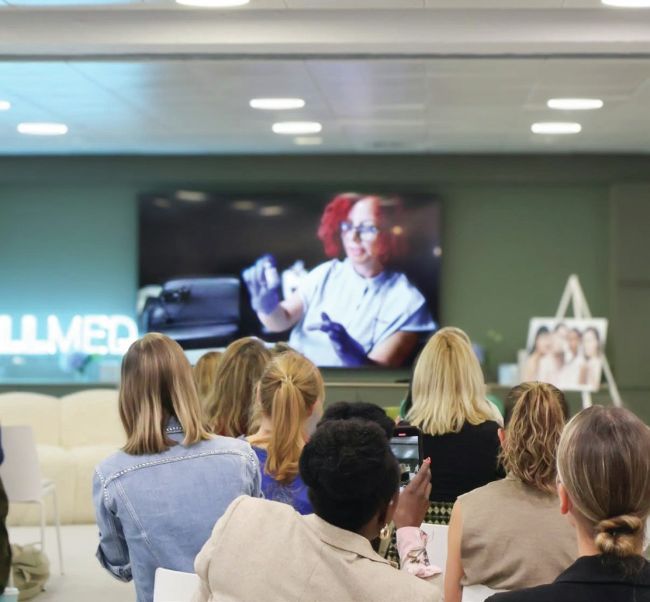
Dr Lisa Dinley in her element. Image courtesy of Fillmed.
FROM DENTISTRY TO AESTHETICS
Dr Dinley’s thirst for knowledge did not initially lead her into aesthetics. She began her career as a dentist specialising in prosthodontics – an area of dentistry focused on function, including bruxism and jaw tension – and had therefore been working with toxins long before entering the aesthetic space.
“My patients would say, ‘Can’t you do this for cosmetic reasons?’” she recalls. “Whatever you are doing is making me feel better and look better.”
18 years ago, encouraged by her patients, she made the transition. “It didn’t take long for me to become hooked,” she says.
Like many clinicians, Dr Dinley initially viewed aesthetics as a vanitydriven sector. “I realised I could make people feel better about themselves, rather than them moaning about coming to the dentist for treatment they didn’t want. It made for a much nicer working environment.”
As a dentist, the move felt natural. “We already have an active, willing audience in front of us,” she explains. As patient numbers grew, dentistry gradually gave way entirely to aesthetics.
She began to specialise in the health benefits of aesthetic treatments, using nonsurgical approaches to address headaches, tooth grinding, snoring and sleeprelated breathing disorders, including sleep apnoea.
WHEN ACCESS GOES TOO FAR
When Dr Dinley first entered aesthetic medicine, treatment options were limited. “There were very few treatments available beyond toxin and filler,” she says.
Like many practitioners, she became her own test subject – but with limited options, the results were not always positive. “Looking back, I was definitely suffering from perception drift,” she reflects. “I saw a photograph of myself after my son was born and I didn’t even recognise myself.”
Referencing Steven Harris’ outspoken stance on professional responsibility, Dr Dinley raises an important question: do practitioners have a duty to speak up when colleagues – or patients – have gone too far?
“I think it depends on the relationship you have with someone,” she says. “But I have gently said something when I felt it was necessary, especially because I’ve been there myself.”
For Dr Dinley, it is essential that patients see natural outcomes and that practitioners truly practise what they preach.
Likes don’t prevent vascular occlusions.
Clout doesn’t teach you anatomy.
RESPONSIBILITY TO THE NEXT GENERATION
As a mother to a teenaged daughter, personalised and natural treatment outcomes matter more than ever.
“I have a responsibility to the younger generation,” she says. “I’ve drummed into my daughter that we’re all meant to be unique, to look different and have our own quirks.”
She openly shows her daughter her work, including beforeandafter images. “I want her to see that I’m not changing people, I’m enhancing and helping them regain confidence. I don’t want her growing up thinking she’s not okay the way she is.”
AESTHETICS, ETHICS AND SOCIAL MEDIA
Social media has transformed the aesthetics industry, and not always for the better. While Dr Dinley works tirelessly to protect patients through education, she believes much of that work is undermined by irresponsible online marketing.
She points to Australia, where strict regulations now limit what doctors can post online. “I’m not saying we should go that far,” she explains, “but I do think governing bodies need to be stricter about what registrants are posting.”
“It’s almost like professional standards are left behind when people enter aesthetics. We’re not influencers.”
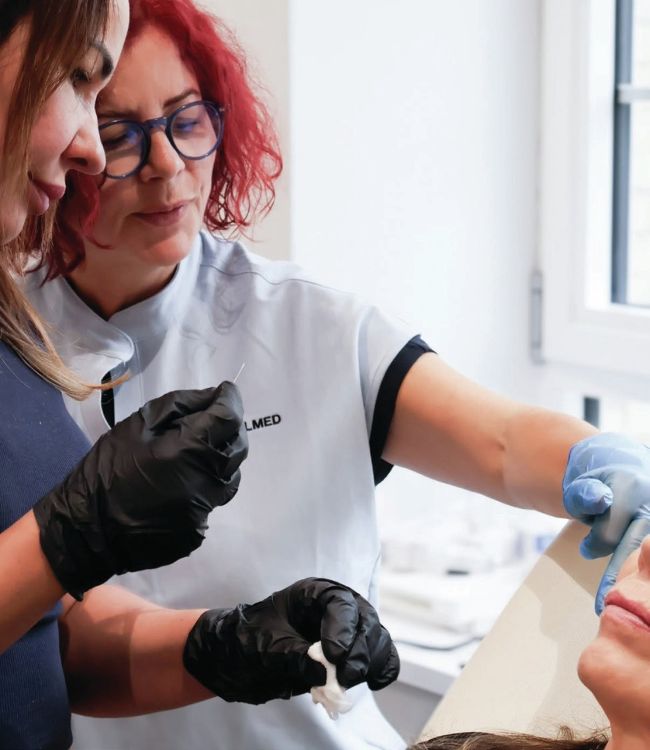
Dr Lisa Dinley training students. Image courtesy of Fillmed.
For Dr Dinley, influence should be educational, not aspirational. “If you’re going to be influential in this sector, it should be in a positive, evidencebased way – not by posting content that makes people doubt themselves or chase an aesthetic ideal.”
Her own social media reflects this ethos: a carefully curated mix of education, professional opinion and the occasional family photo – with no comparisondriven beforeandafters or ‘golden ratios’.
In a recent Instagram post, she summarised her position clearly: “Some trainers want to be influencers. I want you to be safe. In an industry obsessed with follower counts and viral trends, it’s easy to forget what actually matters. Likes don’t prevent vascular occlusions. Clout doesn’t teach you anatomy.
“My goal isn’t to be famous on your feed; it’s to make sure you’re confident, competent and safe in the clinic.”
There’s so much nonsense out there, and some brand marketing is completely out of control.
BUILDING A CLINIC CULTURE THAT PUTS PATIENTS FIRST
Dr Dinley runs Castle Clinic, an unpretentious dental and aesthetics practice in Nottinghamshire, alongside her husband Justin, an endodontist.
Education is central to the clinic’s ethos. “For me, it’s about educating patients and making them feel comfortable. But, I frequently say no. You don’t have to treat everybody.”
“There’s a lovely atmosphere in the surgery. There’s always laughter and conversation between the team and our patients. It feels like a family environment where everyone feels welcome.”
She takes the same approach to training.
“I tell my students about the mistakes I’ve made, because that’s what they’re most afraid of. We’re only human, we can’t be perfect all the time.”
She is keenly aware of how damaging intimidating teaching environments can be. “I’ve been on courses where you feel intimidated by the trainer, and it’s not conducive to learning.”
Her aim is for students to leave feeling empowered. “I hate it when people aren’t given the full information on a course and are then told they need to pay more to learn the rest. People leave with more questions than answers, that’s not fair.”
WHAT’S EXCITING DR DINLEY RIGHT NOW
In clinic and in the literature, Dr Dinley’s current focus is firmly on regenerative medicine.
“Biostimulators are a huge area of interest for me,” she says. “I use them extensively and train in them a lot. I’m always reviewing new research and emerging indications.”
She is also closely following developments in exosomes and the misinformation surrounding them. “There’s so much nonsense out there, and some brand marketing is completely out of control.”
As a member of the International Society for Extracellular Vesicles and through close collaboration with the Exosome Oversight Bureau, she is well placed to separate fact from fiction.
“It’s actually quite scary,” she admits. “There are wellknown brands used in this country that contain no exosomes at all. People are buying into hype and snake oil.”
Another growing interest is microtoxin and its expanding clinical applications. “It’s a relatively straightforward treatment to deliver, but incredibly effective. The nonneuronal pathways that toxin can act on are fascinating.”
For Dr Dinley, innovation only holds value when it is underpinned by evidence, integrity and education – principles that continue to define her clinical practice, her teaching, and her influence on the aesthetics profession as a whole.

The Castle Clinic in Nottinghamshire.