CASE STUDY
A COMBINATION PROTOCOL FOR ADVANCED PHOTOAGEING WITH CONCURRENT ACTINIC KERATOSIS
Dr Tina Bani explores combines Radiofrequency Microneedling and Fractional Thulium Laser to treat photoageing with concurrent actinic keratosis for a 70-year old female patient
Patient: 70-year-old female
Concern: Facial skin ageing, pigmentation, skin laxity and actinic keratosis
Treatment: RF Microneedling with exosomes and polynucleotide injections
Timeline: 8 months
DR TINA BANI
Dr Tina Bani is a GP with 10 years’ experience specialising in aesthetic medicine. Alongside her aesthetic practice, she continues to work as an NHS GP, bringing a medical approach to skin health, ageing and overall wellbeing. Dr Tina graduated from the University of Liverpool Medical School in 2013 before specialising in General Practice. She later completed an MSc in Aesthetic Medicine and Skin Ageing at the University of Manchester. She is the founder and medical director of Skiin, a doctor-led medical aesthetics and skin health clinic in Manchester’s Northern Quarter, where she leads a team of four.
INTRODUCTION
A 70-year-old female presented seeking treatment for advanced facial skin ageing, pigmentation and skin laxity. She had worked as a physical education teacher throughout her career and reported spending approximately 40 years outdoors on a daily basis with prolonged ultraviolet (UV) exposure.
During this period, she had not routinely used sunscreen or adopted regular photoprotective measures.
She was Fitzpatrick skin phototype I, placing her at high risk of cumulative UV-induced skin damage. Although otherwise fit and well, clinical examination demonstrated signs of accelerated cutaneous ageing that were disproportionate to her chronological age.
CLINICAL CONCERNS
Assessment revealed extensive photodamage characterised by diffuse dyschromia, solar lentigines, coarse skin texture, static rhytids and mild-to-moderate skin laxity affecting the face. Overall photoaging was consistent with Glogau Type IV. In addition, a well-defined hyperkeratotic lesion was identified on the left forehead, clinically consistent with an Olsen Grade II actinic keratosis (AK).
The patient was counselled regarding the cumulative effects of chronic UV exposure and the importance of ongoing photoprotection. A broad-spectrum SPF50 sunscreen was recommended together with strict sun avoidance strategies, including the use of protective clothing and hats during outdoor activities. Given the presence of an actinic keratosis, she was referred to her dermatologist for assessment.
MULTIMODAL TREATMENT APPROACH
Following clinical review, the diagnosis was confirmed and approval was provided to proceed with treatment using the Lutronic LaseMD Ultra fractional thulium laser. The LaseMD Ultra has United States Food and Drug Administration (FDA) clearance for the treatment of actinic keratoses.
A multimodal treatment approach was selected to address the patient’s concurrent concerns of advanced photoageing, skin laxity and actinic keratosis.
Device stacking was chosen to maximise collagen remodelling while simultaneously improving epidermal photodamage.
Radiofrequency microneedling was performed using the Lynton Laser Focus Dual. Treatment parameters consisted of a needle depth of 0.8 mm with radiofrequency level 4 for the forehead, periorbital region, nose and neck, and 1.0 mm depth with radiofrequency level 5 for the cheeks to account for regional differences in skin thickness.
Immediately following radiofrequency microneedling, fractional thulium laser resurfacing was performed using the Lutronic LaseMD Ultra. Topical vitamin A was applied following laser treatment to enhance transepidermal delivery through the laser-generated microchannels.
The patient underwent a total of six LaseMD Ultra treatments at two-week intervals to target the actinic keratosis and diffuse photodamage. Alternate treatment sessions incorporated full face radiofrequency microneedling immediately prior to the laser treatment, providing three stacked combination treatments over the treatment course.
THE RESULTS
The treatment protocol was well tolerated without significant adverse effects. Expected transient erythema and mild oedema resolved within several days following each treatment session. No infection, prolonged inflammation, scarring or pigmentary complications were observed. Clinical improvement was evident throughout the treatment course. By completion of the sixth LaseMD Ultra session, the actinic keratosis had regressed from an Olsen Grade II lesion to a barely perceptible Grade I lesion, with almost complete clinical resolution. The patient remained under dermatological surveillance for ongoing assessment, recognising the importance of continued monitoring of actinic keratoses in high-risk individuals.
Significant improvement was also observed in overall skin quality. Diffuse pigmentation and solar lentigines were markedly reduced, resulting in a more uniform complexion. Skin texture became smoother with improved luminosity and a reduction in roughness associated with chronic photodamage. Static rhytids were softened, while overall skin firmness and elasticity improved, particularly within the cheeks and lower face, reflecting the synergistic collage remodelling effects of radiofrequency microneedling and fractional thulium resurfacing.
Using validated aesthetic assessment tools, overall facial photoageing improved from Glogau Type IV to Type III. Wrinkle severity demonstrated an approximate one-grade improvement on the Fitzpatrick Wrinkle Scale, while the overall cosmetic outcome was assessed as “Much Improved” according to the Global Aesthetic Improvement Scale (GAIS).
Standardised clinical photography supported these findings, demonstrating visible reductions in dyschromia, rhytid severity and skin laxity compared with baseline.
CONCLUSION
This case highlights the value of combining radiofrequency microneedling with fractional thulium laser resurfacing in the management of advanced photoageing. Radiofrequency stimulates neocollagenesis and tissue tightening through controlled dermal thermal injury, while the 1927 nm fractional thulium laser effectively targets epidermal photodamage and dyschromia. In this patient, the addition of LaseMD Ultra also enabled treatment of a concurrent actinic keratosis following dermatologist approval, addressing both cosmetic and premalignant pathology within a single treatment programme.
The favourable clinical outcome observed in this case is consistent with the growing body of evidence supporting radiofrequency microneedling (RFMN) for facial rejuvenation. RFMN combines controlled mechanical injury with targeted dermal thermal energy, stimulating neocollagenesis, neoelastogenesis and extracellular matrix remodelling while preserving the epidermis.
Histological studies have demonstrated increased collagen and elastin deposition following treatment, translating clinically into improvements in skin laxity, rhytids and overall skin texture.
Prospective clinical studies have consistently reported significant improvements in facial wrinkles, skin tightening and patient satisfaction, with a favourable safety profile across a range of Fitzpatrick skin types. More recently, systematic reviews have concluded that RFMN is an effective and well-tolerated treatment for facial rejuvenation and photoageing, although they highlight the need for larger, high-quality randomised controlled trials to further standardise treatment protocols.
The rationale for combining radiofrequency microneedling with fractional 1927 nm thulium laser is based on the complementary mechanisms of action of the two technologies. Whereas RFMN primarily induces dermal collagen remodelling and tissue contraction, the thulium laser targets epidermal dyschromia, photodamage and field cancerisation through controlled fractional photothermolysis.
Emerging clinical evidence suggests that combination therapy provides superior improvements in skin tone and overall photoageing compared with radiofrequency microneedling alone, supporting the concept of device stacking for appropriately selected patients.
A multimodal approach combining collagen stimulation, epidermal resurfacing and rigorous photoprotection produced substantial clinical improvement across multiple domains of skin ageing. The favourable safety profile and measurable improvement in validated clinical grading scales support the role of device stacking as an effective treatment strategy for carefully selected patients presenting with severe chronic photodamage
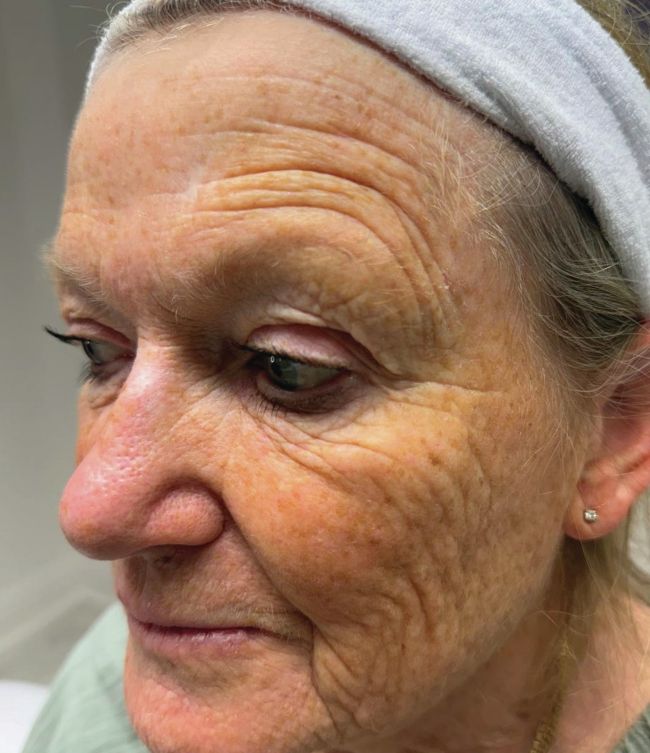
Before
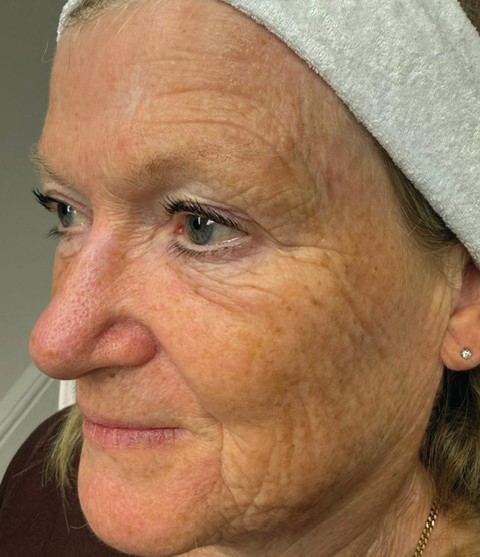
After 8 Months