AI CONSULTATION
AI IN THE CONSULTATION ROOM
From AI-perfect noses to algorithmic beauty scores, patients are bringing a new set of expectations into the consultation room.
Something has changed in my consultation room over the past 18 months and I don’t think enough surgeons are talking about it.
It used to be celebrity photographs. Typically, a patient would arrive with a picture torn from a magazine: a particular nose they admired or a profile they aspired to. That conversation, however challenging, had a built in logic. There was an implicit understanding on both sides that we were looking at a different person, with different anatomy, different skin, a different structural foundation. My job was to understand what it was about that nose that appealed to them, and to work out what was achievable within the reality of their own face.
That conversation has changed. Patients are now arriving with images of their own face, refined, restructured, and digitally “perfected” by artificial intelligence. One in ten of my rhinoplasty patients now presents with an AI generated image at their first consultation. They have uploaded a selfie to ChatGPT or Gemini, typed in a request such as a slimmer tip or a better profile, and arrived with the output as their reference point. The shift feels subtle, but it is not.
When a patient brings in a photograph of someone else, there is an understanding that we are looking at a different person. When they bring in an image of their own face, the psychological distance collapses. This is them, or their version of what they could be. The expectation is no longer aspirational. It feels, to them, attainable. That’s where the clinical challenge begins.
Patients are now arriving with images of their own face, refined, restructured, and digitally “perfected” by artificial intelligence.
THE NEXT AI GENERATION
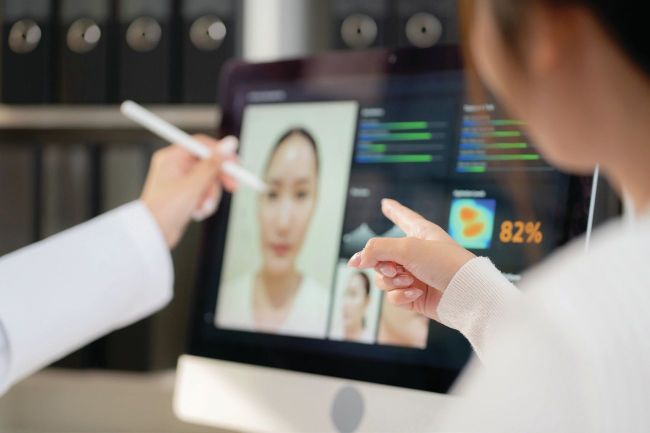
If AI image generation is the first wave, what I am now seeing in the clinic represents something more sophisticated. A growing number of patients are arriving not just with an edited selfie, but with a full protocol report generated by platforms such as Qoves, an
AI facial analysis service that maps over 500 landmarks across the face and runs over 160 aesthetic tests, measuring everything from nasofrontal contour to facial width to height ratio, all benchmarked against ethnic and demographic averages.
It is, by any measure, an impressive piece of technology. The methodology is referenced, the analysis is detailed, and the before and after visualisations are, on screen, visually convincing.
The platform’s stated intent is non-surgical: its protocols are built around lifestyle changes, skincare, and non-invasive approaches. The difficulty is that patients do not always use tools the way their designers intend.
When someone arrives in a surgical consultation with a report telling them their nasofrontal angle deviates from the aesthetic ideal, that report has already framed the conversation before I have had the opportunity to assess what is actually in front of me.
WHAT AI CANNOT REPLACE
When I assess a patient for rhinoplasty, I am not looking at a photograph. I am assessing nasal skin thickness and sebaceous quality, the structural integrity of the upper and lower lateral cartilages, the integrity of the osseocartilaginous vault, septal deviation and how all of these structures sit in three dimensional relationship with the rest of the face. I am thinking about how a change to the nasal tip will affect the nasolabial angle. I am considering how skin will redrape over a reshaped framework through a healing process that unfolds over twelve to eighteen months. In my hands I can control 70-80% of a rhinoplasty but there are always unpredictables in surgery – healing, swelling and scarring varies between individuals so there will always be variations between the simulations and true final surgical result.
No AI tool, however sophisticated its landmark mapping, can assess any of this from a photograph. It is working in two dimensions on a three dimensional structure, with no access to the tissue, the cartilage, or the anatomy beneath the surface. When it generates a visualisation of what a patient could look like, it is editing pixels. It is not modelling a surgery.
THE DANGERS OF ‘BEAUTYMAXXING’
I want to be careful here, because I am not simply making a point about technology. I am increasingly concerned about what is driving patients to these tools in the first place.
A significant proportion of the patients arriving with AI generated images are younger, in their late teens and twenties and many have come via a social media trend known as ‘beautymaxxing’: the systematic optimisation of one’s appearance through every available means. The movement has its own vocabulary, its own forums, its own metrics. Patients arrive having already conducted what amounts to a self-directed aesthetic audit, cross-referencing their features against algorithmic beauty standards absorbed over months or years of social media engagement.
I would be dishonest if I said I had no concerns about the psychological environment in which some of these patients are forming their expectations. The ability to upload a photograph and receive an instant, detailed assessment of everything that deviates from an aesthetic ideal is not a neutral act, regardless of how the tool is packaged or what it claims to be based on. For a patient who is already hyperaware of their appearance, that kind of feedback does not clarify their goals but rather deepens the fixation.
A peer-reviewed study published in Aesthetic Plastic Surgery found that patients with prior exposure to AI image enhancement held significantly higher expectations for surgical outcomes across all measures and may be predisposed to lower satisfaction after surgery. That finding matches what I am seeing in practice.
WHAT I WOULD LIKE TO SEE CHANGE
I am not opposed to AI in medicine. There are genuine and important applications for machine learning in surgical planning, imaging, and outcomes tracking. Used well, AI will make surgery safer and results more predictable.
What I am asking for is a clearer distinction, from platforms, from regulators, and from the broader conversation around these tools, between AI as an instrument of clinical assessment and AI as a consumer product optimised for engagement. Those are different things, and they carry different responsibilities.
In the meantime, my advice to any patient who has used one of these tools is the same: bring the report if you like. Tell me what it said. But then put it to one side, and let us talk about your concerns, not the algorithm’s version of them.
The best outcome I can give any patient is one that looks entirely natural, functions properly, and suits the face in front of me. That is not something an AI generated image can tell me.
Scan for references:
MR SAMIT UNADKAT
Mr Samit Unadkat FRCS is the rhinoplasty surgeon for patients who would rather look like they have not had one. An ENT surgeon by trade, he chose to dedicate his career to a single anatomical region: the nose. He runs a thriving private practice, My Nose London, while continuing to treat the country’s most complex nasal cases on the NHS at the UK’s national centre for complex sinonasal and facial plastic disorders. He holds Double Board-Certification in Facial Plastic Surgery – a rare UK credential – and is the Course Director of the UK’s oldest rhinoplasty course at UCL. His philosophy is function before form, delivering aesthetic results built on deep medical expertise.