CLINICAL
TREATING THE CHINESE FACE
Anatomy, Aesthetic Identity, and a Case-Based Approach
DR MEI-YING YEOH
Dr. Mei is a dentist specialising in aesthetics. With a background in Maxillofacial Surgery and experience as a general dentist, she brings a unique blend of expertise. She is passionate about holistic facial and neck treatments, focusing on precision and innovative techniques for delivering injectables to achieve optimal patient results.
Aesthetic training in the West focuses heavily on Caucasian facial landmarks and proportions, and much of the injectable and device education available to practitioners is built around them. This sits within a wider training gap in UK clinical education: patients presenting for dermatology and aesthetic treatment are increasingly diverse, including growing numbers of mixed-heritage patients, yet formal training in assessing non-Caucasian facial anatomy and skin remains limited.
When treating a Chinese patient, the standard Caucasian-derived framework can work against the anatomy and aesthetic the patient actually presents with. The neoclassical canons and the golden ratio, both derived from historical Western artistic ideals rather than population data, have repeatedly failed to hold when tested against real facial data across ethnic groups, including mixed-race populations. This article sets out an approach to assessing and treating the Chinese face: the anatomical differences that matter, why “Chinese beauty standards” is not a single fixed target, and a full case, from initial dissolve through to the completed filler plan, that illustrates the approach in practice.
WHY THE CAUCASIAN AND NEOCLASSICAL TEMPLATE DOESN’T TRANSFER
Much of Western aesthetic training assumes a face that loses malar volume and midface projection with age, so treatment leans heavily on restoring anterior and lateral cheek fullness. Applied to a Chinese face, this can easily produce the opposite of the intended result.
The neoclassical canons and the golden ratio (phi, approximately 1.618) that still underpin much facial analysis were derived from Renaissance and classical Western sculpture, not from population data. When tested systematically against real faces, both frameworks fail to hold consistently across ethnic groups: a large anthropometric analysis found significant interethnic variation across multiple canons and concluded that no ethnic or gender group consistently approximated either the neoclassical ideal or the golden ratio. Comparable findings have been reported in Malaysian Chinese, Malay, and Indian populations, where conformity to the golden ratio showed no association with perceived facial attractiveness, and in African-Caribbean faces, where eleven of twelve measured facial ratios deviated significantly from the golden proportion. A 2023 population-modelling study using three-dimensional facial databases concluded that the neoclassical canons are “no longer fit for purpose” when used to judge beauty in non-Caucasian faces.
As more patients of mixed heritage present for treatment, a fixed proportional template becomes even less appropriate, since mixed-heritage anatomy routinely falls outside any single ethnic normative dataset, let alone a Eurocentric one.
Comparative anatomical studies support a related, more specific distinction for East Asian faces, which differ in direction as well as degree: East Asian faces tend to have a wider, more laterally and anteriorly positioned zygomatic (cheekbone) complex, a flatter, less projected nasal dorsum, a more obtuse nasofrontal angle, and a comparatively retruded mandibular and chin profile relative to the midface.
CHINESE CRANIOFACIAL ANATOMY: A MORE PRECISE PICTURE
In many Chinese patients, the lateral zygomatic body and arch are anteriorly and laterally prominent, a feature recognised commonly enough in East Asian facial contouring that surgical zygomatic reduction is an established procedure, with newer, less invasive techniques such as targeted zygomatic arch liposuction recently introduced to soften this lateral projection. At the same time, the medial and paranasal maxilla, the central midface adjacent to the nose and pyriform aperture, is frequently under projected. This paranasal concavity is common enough in Asian populations that paranasal augmentation has become a popular adjunct to rhinoplasty, addressing a deficiency that is distinct from, and often the opposite of, the lateral cheekbone prominence in the same face. The same patient can therefore present with excess lateral cheek width and a deficient central midface simultaneously, a combination that a single “add volume to the cheek” protocol cannot address, and may actively worsen.
This under projection typically continues along the facial midline. The nasal dorsum is frequently flatter and less projected than in Caucasian faces, with a more obtuse nasofrontal angle, and the chin is frequently both shorter and set further back, contributing to a comparatively retruded lower facial profile relative to the midface (Gao et al., 2018). Clinically, this means the midline of the Chinese face (nasal bridge, central midface, and chin) often benefits from added projection, while the lateral cheek, in many patients, needs restraint or reduction rather than further volume.
Masseter hypertrophy is a common presenting concern in Chinese and East Asian patients seeking facial contouring: a prominent masseter reinforces the square, wide lower face that runs against the narrow, tapered jawline documented as the preferred ideal in this population, which is why botulinum toxin to the masseter has become an established contouring technique (Cheng et al., 2019). Masseter size is also genuinely linked to occlusal function, so it is worth assessing whether occlusion is contributing before treating a hypertrophic masseter as a purely muscular finding. A narrative review has associated greater masseter cross-sectional area and stronger masseteric occlusal force with a brachyfacial (shorter, more square) growth pattern and deep dental occlusion (Kumar & Pillai, 2012); where this is present, dental assessment alongside botulinum toxin may be more appropriate than botulinum toxin alone. Skeletal classification within Chinese populations is heterogeneous rather than uniform: a large ethnic Chinese orthodontic cohort found Class I relationships most prevalent, at 49.5%, with Class III slightly more common than Class II (27.4% versus 23.1%). In practice, this means assessing dental occlusion, the mandible, and the masseter individually rather than assuming a pattern from ethnicity.
CHINESE BEAUTY STANDARDS ARE NOT A SINGLE STANDARD
A further point is equally relevant before any treatment plan is built: there is no single “Chinese aesthetic ideal” to work towards. What a patient considers beautiful depends considerably on where she was raised.
Large surveys of the mainland Chinese population consistently show a preference for an oval or heart-shaped face, a narrow midface and jaw, a straight facial profile, and a slim, tapered chin, a soft V-shape rather than added width or projection. This is echoed in consensus statements from leading Asian aesthetic practitioners, who are explicit that treatment should not aim at Westernisation, but at optimising the features a patient already has.
Patients who are ethnically Chinese but were raised in the UK or another Western country often hold a different, and at times conflicting, reference point. One US-based study of East Asian university students found a measurable discrepancy between perceived actual and ideal facial appearance: participants idealised a somewhat more Western-influenced phenotype than their own . No equivalent UK data exists, but the finding supports treating this as an open question for each patient rather than an assumption. In practice, two Chinese patients may present with genuinely different aesthetic goals, shaped by upbringing and identity rather than bone structure alone, and this warrants direct discussion in consultation. Standards within mainland China have also shifted over time; injectable treatment is now considerably more accepted than a decade ago, although the underlying preference for a narrow, tapered lower face has remained consistent across national surveys.
CASE STUDY
A Chinese woman in her late thirties presented having previously undergone a course of dermal filler at another clinic. On animation, filler in the midface and cheeks lifted superiorly, making her eyes appear smaller when she smiled, and she described her overall appearance as looking “hard and heavy” rather than soft. This pattern, blunted natural contour transitions and restricted dynamic movement following filler placement, is consistent with what has recently been described in the literature as overfilled face syndrome. On examination, filler had been placed predominantly over the lateral zygomatic arch and lateral cheek. On three-quarter profile, the ogee curve, the smooth concave-to-convex line that should run from the hollow of the mid-cheek into the malar prominence and down toward the chin , had been exaggerated into an abrupt, pronounced S-shape rather than a soft, continuous contour. Given her pre-existing skeletal cheek width, the additional lateral volume had widened her face rather than restored balance to it. She voiced that she did not feel her ethnicity had been considered in her original treatment plan.
The treatment plan comprised three stages.
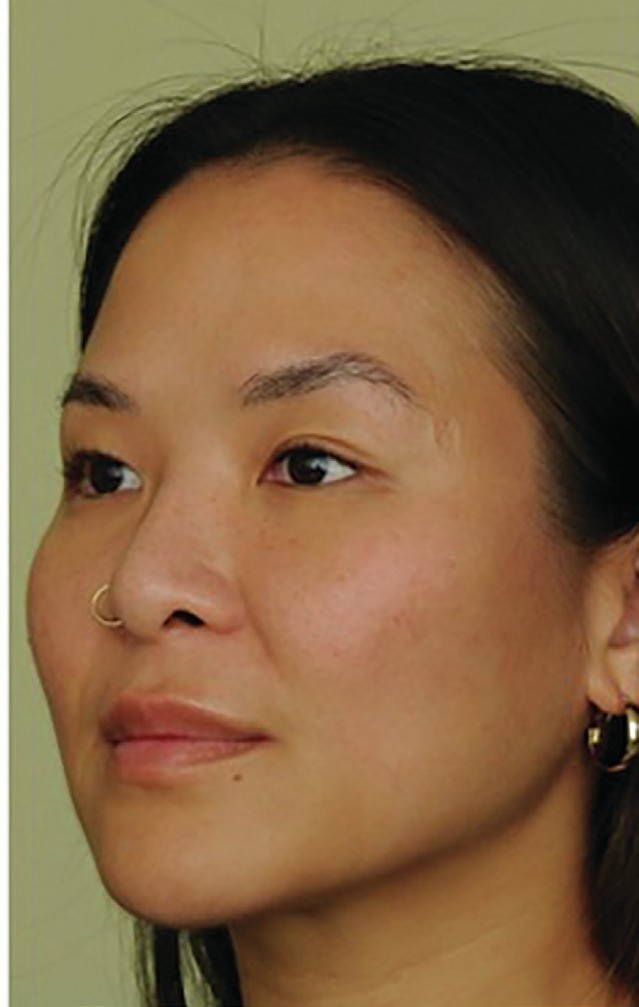
Before
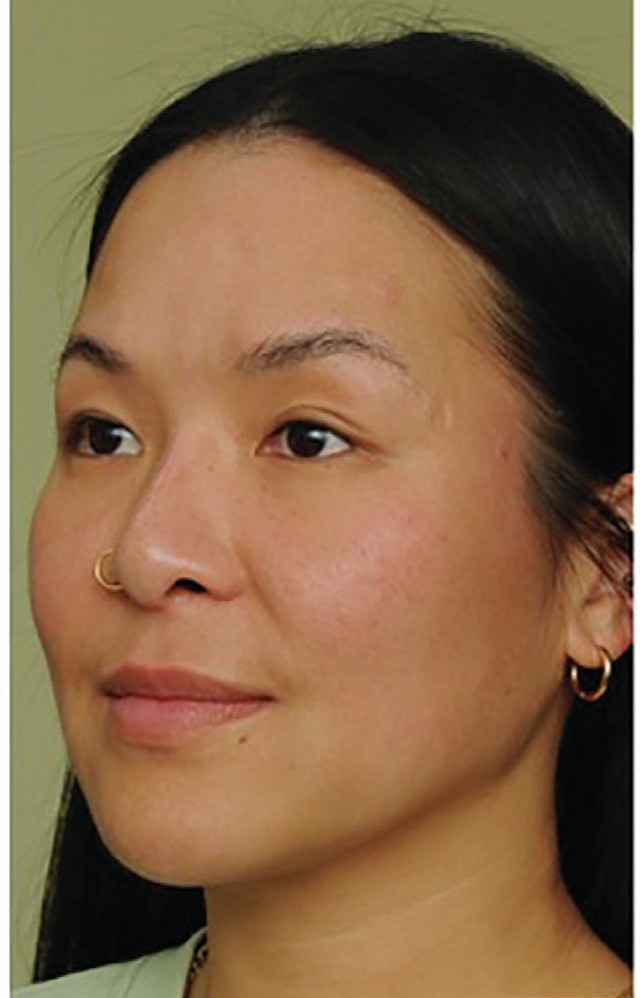
After full face dissolve
Stage 1: Full-face dissolve. Hyaluronidase (Hylase 1500 units, reconstituted in 5ml saline) was used across the previously treated areas, allowing the native anatomy to re-establish itself before any new treatment plan was built. This step is necessary whenever existing filler is contributing to the presenting concern; further product placed over misplaced filler rarely corrects it.
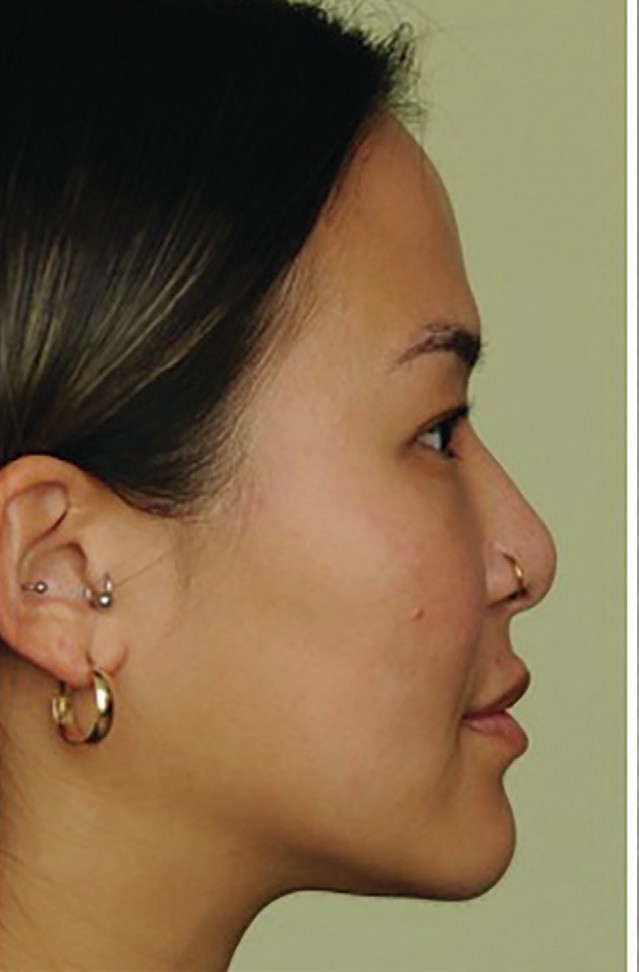
Before stage 2
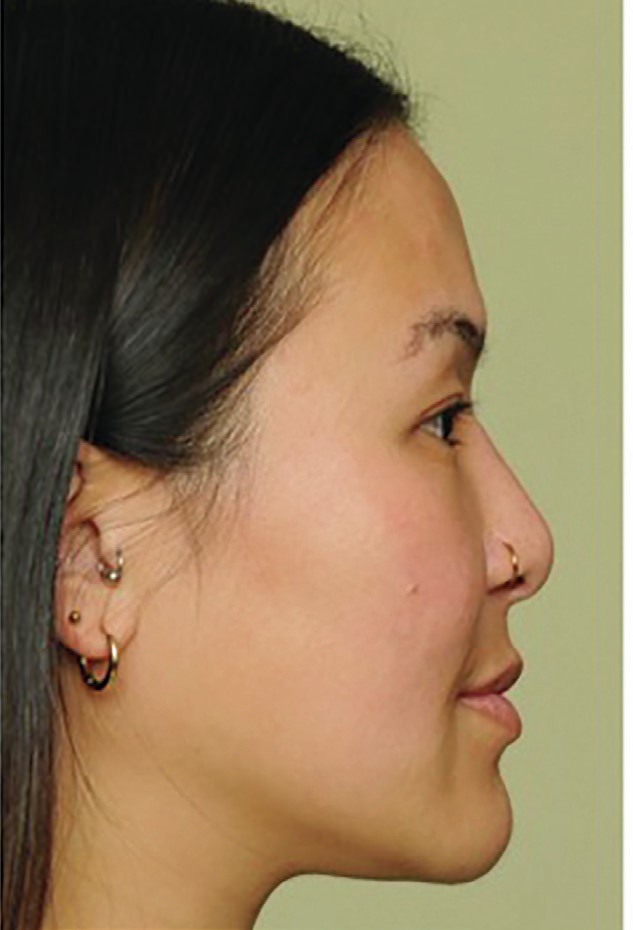
After structural foundation
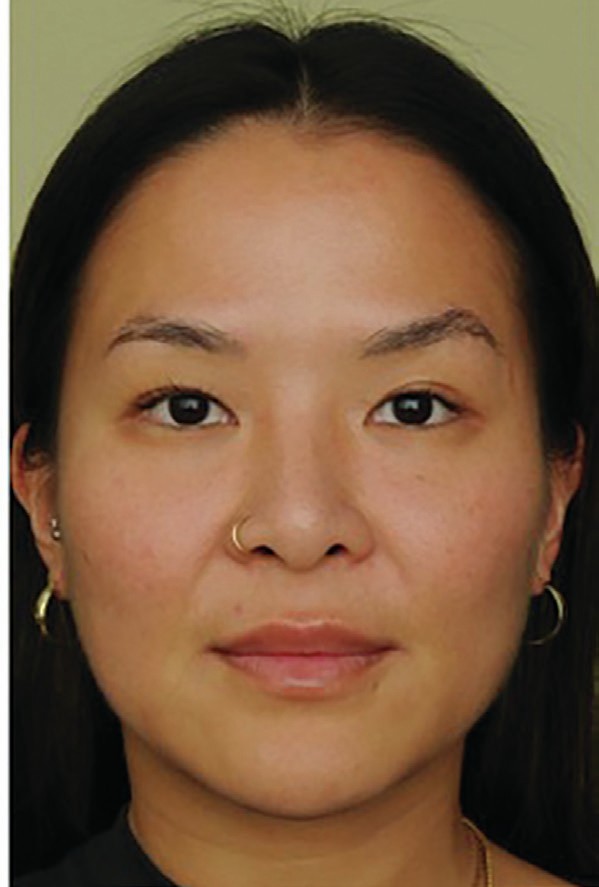
Before stage 3
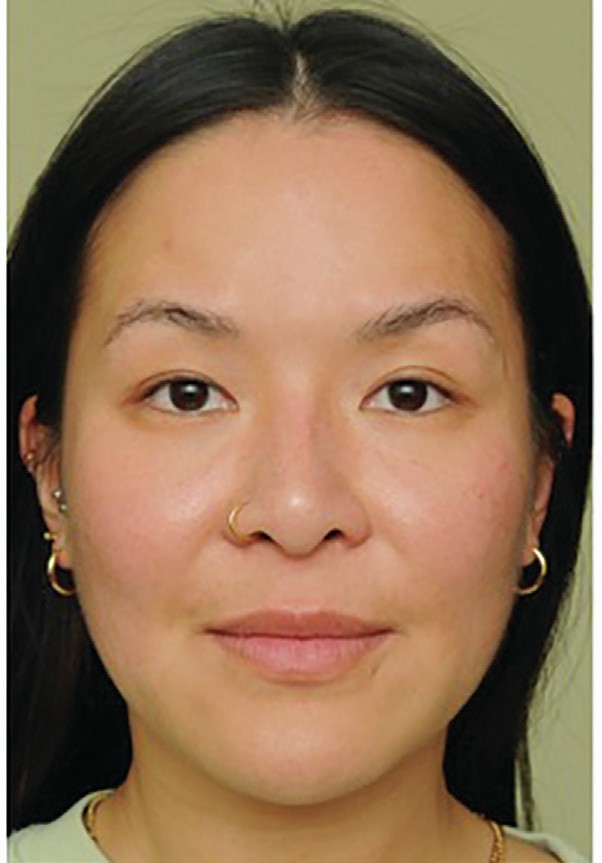
After filler with a micro-cannula technique
Stage 2: Structural foundation with HIFU and masseter botulinum toxin. Once the skin had settled, high-intensity focused ultrasound (HIFU) was used to improve jawline definition through collagen stimulation and tissue tightening, an approach with reasonable evidence for skin laxity and lower-face contouring. Botulinum toxin was injected into the masseter muscles to gradually soften a squarer jaw angle, a well-established technique for lower-face contouring in East Asian patients seeking a narrower jaw, with good safety data across multiple studies. Addressing these first meant the subsequent filler plan was built around the shape the face was settling into, rather than the shape it started in.
Stage 3: Filler with a micro-cannula technique. Treatment was staged from the upper face down, restoring central and medial projection before addressing transition lines, and used Precision32 micro-cannulas throughout, with gauge and length selected per area for glide, control and low extrusion force.
• Forehead: 1ml Belotero Intense over three entry points, using a Precision32 22G, 50mm cannula for its glide and low extrusion force in this high-risk area. The goal was added projection and roundness, a contour that also carries cultural significance in Chinese aesthetics as a sign of good fortune.
• Temples: 1ml Belotero Balance per side, entering at the zygomatic arch and fanning into the hairline with a Precision32 25G, 50mm cannula.
• Midface: Belotero Volume 0.5ml per side via a Precision32 25G, 50mm cannula. Anteromedial cheek only, deliberately avoiding the lateral cheek and zygomatic arch. This follows a well-supported principle: midface volume in Asian patients should generally be restored medially before any lateral augmentation is considered, since injecting the zygomatic arch first risks an exaggerated, widened lateral projection.
• Nose: microdroplet technique using Stylage XXL, 0.4ml in total.
• Nasolabial folds: 0.5ml Belotero Intense per side via a Precision32 25G, 40mm cannula.
• Chin and Chin shadows: 0.5ml per side Belotero Volume via a Precision32 25G, 50mm cannula. Temple and forehead volume corrected the hollowing that had been drawing attention to the width of the lower face, while treatment of the nasolabial folds and chin shadows softened the transition lines that had made the midface appear heavier than it was.
OUTCOME AND DISCUSSION
The result was a face that appeared rested and refined rather than altered: narrower through the mid and lower face, with the patient’s own cheekbone structure intact but no longer the dominant feature. The patient described the outcome as looking like herself, only more refined.
Ethnic features should be preserved and enhanced, not erased in favour of a Caucasian or neoclassical ideal that was never derived from her anatomy.
We should consider the anatomy of the ethnicity being treated: the difference between lateral zygomatic prominence and central midface deficiency, the relationship between dental occlusion, the mandible, and masseter size, and the aesthetic norms specific to the patient’s population. Training in this area remains limited in the UK, a gap we should be looking to close. Second, a thorough consultation that establishes the individual patient’s own reference point rather than assuming one from her ethnicity, particularly for UK-born or Western-raised Chinese patients, whose aesthetic ideals may differ from those raised in mainland China.
Applied to this case, that means assessing the medial and lateral midface as separate structures, examining dental occlusion, the mandible, and the masseter individually rather than assuming a pattern from ethnicity, sequencing structural treatment before volumetric treatment, and asking the patient directly what she considers beautiful before building a plan around it.
Scan for references: