Getting to know…
DR JORDAN FAULKNER
From a junior doctor sceptical of overfilled faces to a full-time cosmetic physician, educator and mentor, Dr Jordan Faulkner has built a career around questioning convention. Kezia Parkins speaks to the Allo Aesthetics founder about leaving the NHS, near-peer mentorship, resisting scope creep and why integrity must come before opportunity.
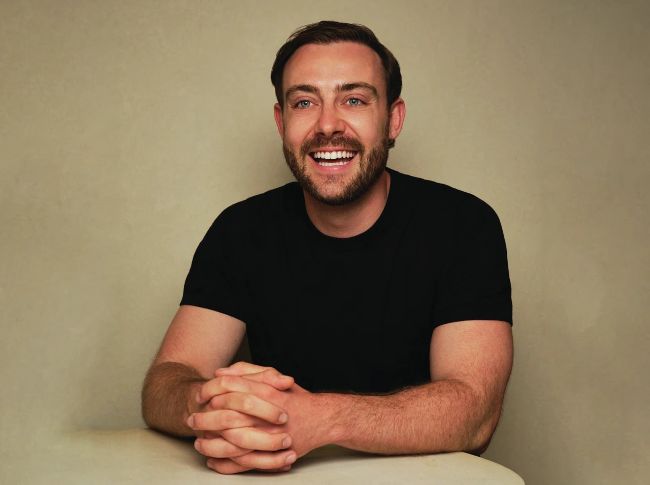
DR JORDAN FAULKNER
Dr Jordan Faulkner is, in many ways, the epitome of a next-generation aesthetic practitioner. Young, highly educated, down-to-earth and deeply invested in collaboration, he has built his career in a sector that can still be surprisingly siloed. It is perhaps ironic, then, that his first impressions of aesthetic medicine were far from favourable.
“I noticed how certain demographics in the country are more likely to have the kind of overfilled look, and the North East is one of them, as well as Yorkshire, where I’m originally from,” he says. “That had been my overview of what aesthetic medicine meant: overfilled cheeks, overfilled lips and distortion of the face.”
Still, something about the aesthetic side of medicine had piqued his interest. After initially imagining a future in Australia, Faulkner became increasingly drawn towards surgery, particularly plastics, and moved to London to work at Chelsea and Westminster Hospital.
“We would be looking at scans of the head and neck day in, day out, managing the soft tissues of the face when people had sustained injuries or trauma, looking at X-rays, CTs, sometimes even MRIs,” he explains. “All of these things really layer your understanding of the anatomy of the face.”
Many of his peers in plastics had started to dabble in aesthetics. It began to look less like the caricature he had dismissed and more like an extension of the skills he was developing. There was also a practical consideration.
“Let’s be real. It is not easy living in London on SHO wages.”
He began hunting for courses and came across Interface Aesthetics, founded by maxillofacial surgeon James Olding. “There were a lot of similarities between us. He got what I’m about, and we understood each other’s language.”
Faulkner completed his foundation and advanced training back-to-back in March 2021, during lockdown. “Four weeks later, I did my first injections on the first day out of lockdown. It all took off from there.”
HELLO ALLO
At first, aesthetics was intended to be a side hustle. Even the name Allo Aesthetics was partly a way of keeping some distance between his new venture and his surgical career.
“You hear stories about plastic surgery consultants making it hard for juniors who dabble in aesthetics,” he says. “I didn’t experience it myself, but there is an undercurrent.”
“Allo Aesthetics was created as a bit of a veneer to hide behind because I really didn’t want it to affect my NHS career, which at the time was my main priority.”
A move into orthopaedics changed the dynamic.
“There’s no reason why orthopaedic consultants would care if one of their juniors did aesthetics because essentially there is no competition,” he says. “That gave me the freedom to really pursue it. I started turning up online and on socials as Dr Jordan Faulkner, and really taking ownership of the fact that I am involved in aesthetics and proud to be.”
The name stayed. Allo derives from the Greek allos, meaning “other” or “different”, an idea that now feels less like a disguise and more like a statement of intent.
PUSH AND PULL
The real turning point came when Faulkner reached a crossroads in both career and life. Orthopaedics was going well, and he had the option to move back north. At the same time, his aesthetics career in London was gaining momentum and was beginning to fall in love with the specialty. It became increasingly difficult to view as simply a sideline.
“I think whenever you make a massive change in life, whether that be a relationship, a job, moving house or to another city, there are push factors, and there are pull factors,” he says.
"People were looking for near-peer support, so I started leaning into mentorship. That’s been, what I would say, one of the most defining elements of my career. "
Faulkner was familiar with the pressures of NHS life, from financial strain to burnout, but, for him aesthetics became a real passion, rather than an escape route.
“I never saw aesthetic medicine as a get-out-of-jail-free card,” he says. “When people have that mentality, they’re setting themselves up for failure because the market is saturated and highly competitive.
“There are plenty who not only have the skill but a true passion. They’re the ones who will really succeed because you have to live and breathe it, invest and reinvest, and do that for a long time before it starts making you money.”
“We know that aesthetic medicine can be lucrative compared to the average NHS post. That’s no secret. But that can’t be the whole reason for the shift.”
For Faulkner, what made the work stick was the immediacy of the patient relationship.
“As a junior doctor, you work so hard. Long days, nights, weekends, extra shifts, and you don’t really get any kind of positive feedback or a thank you. You might never see that patient again,” he says.

Dr Faulkner with fellow practitioner and partner Eleanor Hartley
“All of a sudden, you set up your aesthetics business and, at the end of the treatment, people can be enormously happy and thankful. The immediate reward is so tangible, and the visible difference that you can have on someone’s life in such a short period of time is incredible.” And to those who joke about whether he misses “real medicine”? “For me, the areas of traditional medicine I find most rewarding are amplified in aesthetics. It’s so fulfilling.”
MAKING OF THE MENTOR
Showing up online early in his aesthetics career opened the sector up to Faulkner and, he believes, accelerated his progress.
“I think people really invest in people,” he says. “When I started posting, I saw myself as someone who wanted to bring improvements to aesthetics. I positioned myself as someone who provides education both to patients but also to newer injectors, probably earlier than you might ever expect.”
It was not, he stresses, borne from arrogance or any “God-given right to be good”. Instead, he had noticed something missing from aesthetics that was far more embedded in other areas of medicine: structured support from colleagues.
Around a year into his aesthetics career, an old medical school colleague entering the specialty reached out for guidance.
“That told me that people were looking for near-peer support, so I started leaning into mentorship. That’s been, what I would say, one of the most defining elements of my career.”
“There are many positives about aesthetic medicine compared to typical NHS life in terms of fluidity, the ability to impart your personality and make it your own,” he says. “But there are also loads of things that the NHS is doing so much better than we are in aesthetics.” Mentorship is one of them. That conviction evolved into Unite Aesthetics Initiative, a UK-wide network of medical aesthetic injectors built around collaboration, mentorship and professional growth. Its aim is to make independent practice feel less isolated, particularly for clinicians used to NHS environments where a second opinion is rarely far away.
“It started as a very linear one-to-one remote business, providing guidance from someone who is a few steps ahead,” he explains. “But what I realised was missing was that unity and collaboration, especially with things relating to complication management and building a business.”
“The ability to affiliate with something central that we can all subscribe to and be proud of, that helps us all to improve as clinicians, but also have our own separate entities, I think is what has made it successful.”
Faulkner takes everyone who is curious about joining the initiative for a coffee.
“Your network is your net worth. Even in just an hour of two peers meeting, so many pearls of wisdom can be shared. Even if the mentorship is not right for them, for whatever reason, we’ve built a relationship, which is so valuable.”
THE AUTHENTICITY TIGHTROPE
That emphasis on relationships also shapes the way Faulkner presents himself online. His approachability is part of his appeal, but he admits there are pitfalls to bringing too much of yourself to social media.
“Trying to be relatable, authentic and turn up as your genuine self to attract the people who are going to resonate with you, without pushing it and letting go of your professionalism, is a really, really tight balancing act.”
“I am a northern boy, a cheeky chappy. I like to have a laugh sometimes, but there has to be a line.”
For him, that is another argument for having trusted people around you who are willing to quietly call you out.
“I always listen because if one person thinks it, someone else will. But I don’t think that we should vilify ourselves for being a person before we are a doctor. We are all human beings before we are doctors.
“People appreciate a little bit of personality. It helps build the rapport that we have with our patients. You really know them, and they really know you, and some of that is because of social media.”
We need to stop misusing words and get in front of the science.
SCIENCE BEFORE SEMANTICS
If collaboration is one thread running through Faulkner’s career, scientific rigour is another. He is particularly alert to what happens when aesthetic medicine expands faster than clinical frameworks can keep up.
“Aesthetic practitioners have become the GPs of anything that has a visible element to it,” he says. “But we need to remember that scope creep is so present in aesthetics because we haven’t got set protocols, guidelines and referral pathways that are widely adopted.”
“We have to be really careful to remember that we are a referring specialty.”
The warning feels especially relevant as aesthetics increasingly overlaps with wellness, regenerative medicine and longevity.
“But things like functional medicine are a whole separate qualification in themselves. We don’t all of a sudden get to pivot and rebrand ourselves.”
For an evidence-led doctor, the current enthusiasm is, in his words, both “amazing, but petrifying”.
“There’s so much room for opportunity and growth, but there is also so much room for disaster.” He points to “regenerative” as a case in point. “Regenerative is a term that’s been taken largely from stem cell therapy. I don’t think it’s necessarily a bad thing that the term has become a little bit broader and started to encompass other treatments. The idea behind it, in terms of trying to restore physiological architecture rather than just mask it, I think is a good thing.
“But there are loads of treatments that, frankly, aren’t regenerative because they’re not taking the tissue back to where it was. They’re doing something completely different.” The issue, for Faulkner, is whether the language used by clinicians and companies can stand up to scientific scrutiny.
“What we are often seeing is a real stretch of that term. We need to be really careful with semantics because they’re not just marketing buzzwords. They have scientific definitions attached to them. We need to stop misusing words and get in front of the science.” “We need to give ourselves the authority as clinicians to hold industry accountable when they use terms that are prioritising marketing over science if we want to actually garner respect and maintain that level of professionalism and integrity that other specialties have.”
FACING THE FUTURE
That concern with integrity influences the commercial decisions Faulkner makes. He is selective about the brands he works with and unequivocal about the reputational cost of promoting something he does not genuinely believe in.
“As a clinician, if your integrity is gone, what do you actually stand for?” he asks. “I think putting your face and your name to a brand that isn’t truly in your cupboard, that you don’t truly love or haven’t made your mind up on yet, is a quick-fire way to visibly, publicly hinder your integrity. And integrity has to come before everything as a clinician.”
It is an interesting position for someone who has now stepped into product development himself. Faulkner is the co-founder of Myokine, a performance skincare brand created around the needs of active people and post-workout skin. The move broadens a portfolio that already includes Allo Aesthetics, Unite Aesthetics Initiative and clinical education.
Yet the different strands of his career do not feel disconnected. They are all, in one way or another, about trying to improve the systems around the patient and practitioner: better education, stronger networks, more defensible science and products designed to solve a defined problem rather than follow a trend.
Perhaps that is why the name Allo still fits. “Different” for Faulkner does not appear to mean chasing novelty for novelty’s sake. It means questioning why aesthetics works the way it does, borrowing the best of traditional medicine and challenging the parts of the industry that do not stand up to scrutiny.
For a doctor who once thought aesthetic medicine amounted to overfilling and distortion, it is quite the turnaround.
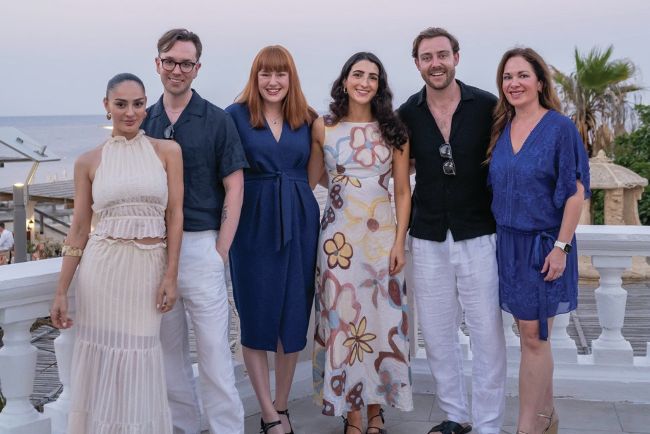
Dr Faulkner and Hartley in community with peers.